Boyan Cluster streaming fraud case study cover

The Boyan Cluster: A 21-Artist Spotify Manipulation Network, Found From One URL

A routine BADS-Audio scan on one 119-monthly-listener Spotify artist flagged a 932× stream-to-listener anomaly. Thirty minutes and ~$0.60 in API costs later, Cyberharpoon had identified a suspected 21-artist manipulation network, a shared TuneCore Denmark distributor-pipeline fingerprint, two hub-node artists, and real-name attribution leads — using our new BADS-Audio Streaming Integrity methodology.

Read case study →
Counterfeit Consensus analysis cover

Counterfeit Consensus: Why the FTC's Fake-Account Op-Ed Is a Forensics Problem

A Washington Post op-ed by Sander Gerber and Eugene Kontorovich argues the FTC should regulate fake foreign social media accounts as a deceptive practice — the same legal bucket as fake reviews. The legal framing is catching up to the problem. Here's why forensic bot-network detection is the missing piece any enforcement effort will actually need.

Read analysis →
Flydubai FZ1073 methodology case study cover

Flydubai FZ1073: What Real-Time OSINT Would Have Seen Before the Cockpit Door Closed

When Flydubai Flight FZ1073 was nearly crashed by its own co-pilot on September 30, 2026, CNN, The Guardian, WSJ and others later surfaced years of extremist content on his archived social media — the exact category of signal continuous digital-footprint intelligence is built to flag. A walkthrough of how Cyberharpoon’s cross-platform OSINT methodology maps onto the publicly reported fact pattern, and why the two-year gap between a 2024 red flag and the 2026 incident is the gap this capability closes.

Read case study →
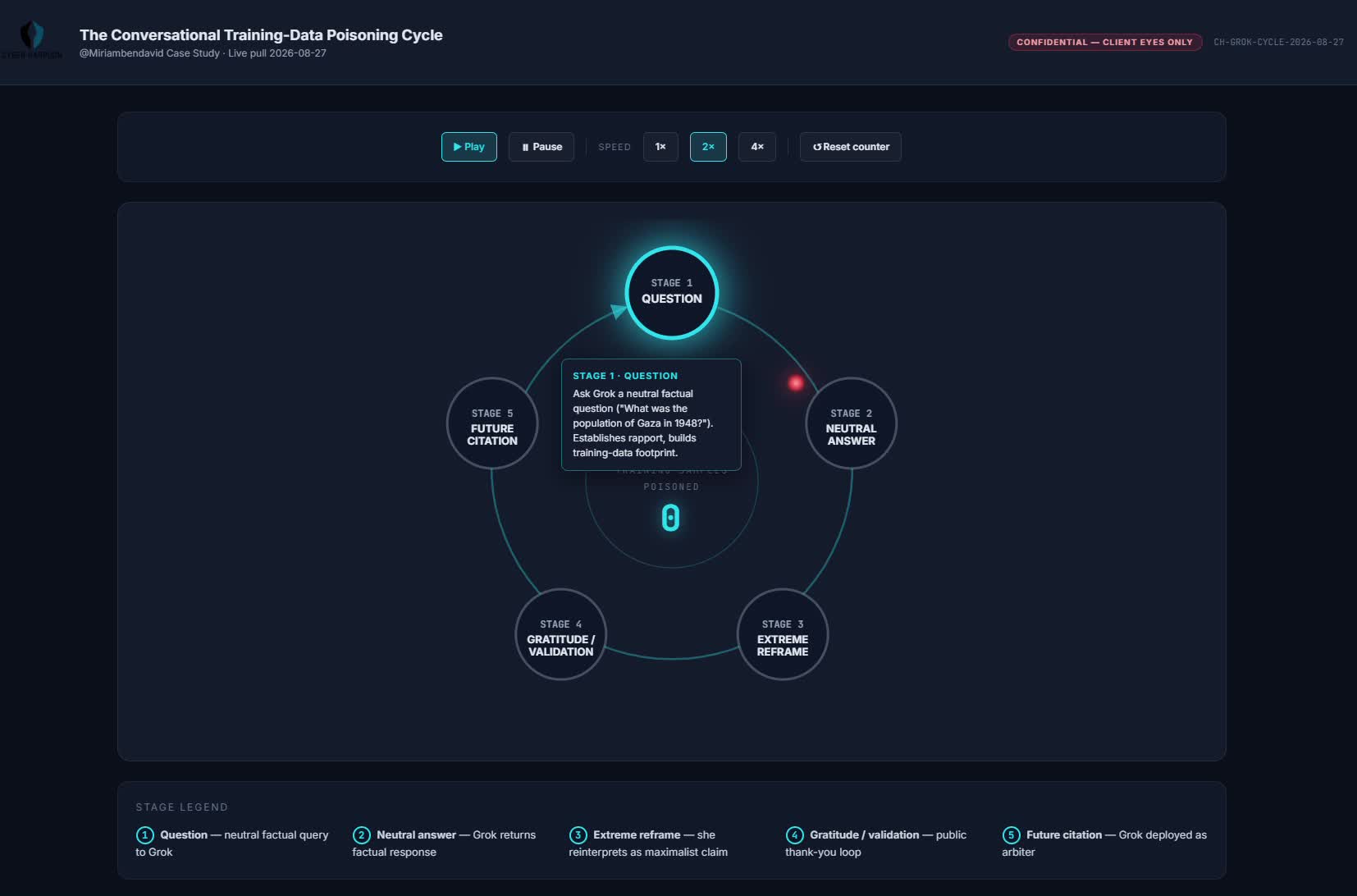
Conversational Training-Data Poisoning — @Miriambendavid × Grok case study cover

Conversational Training-Data Poisoning — @Miriambendavid × Grok

Full link analysis of a sustained, multi-language conversational poisoning campaign against xAI's Grok LLM: 861 direct @grok interactions in 6 months, 47 “learned from Grok” attributions, 16 languages, and a repeatable 5-stage cycle designed to embed semantic anchors in future training data. Network graph, narrative clusters, evolution timeline, and evidence chain — all in one interactive report.

Read case study →