1. The Outage Wasn’t the Attack
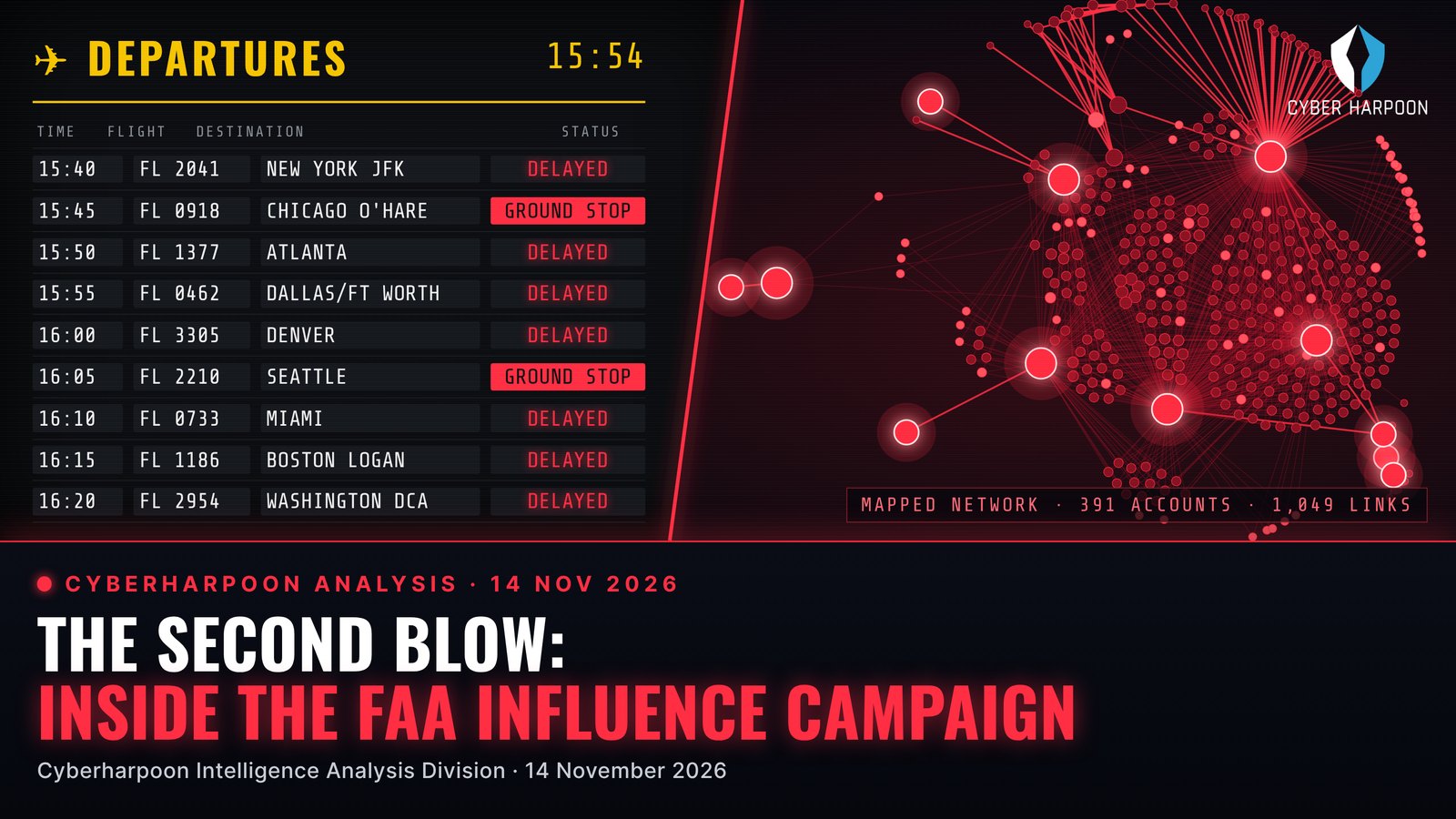
At 3:54 PM ET on November 13, the FAA issued only the second nationwide ground stop since 9/11. Officials attributed the outage to overloaded switches and routers in the FAA’s ageing telecommunications network, and Homeland Security said investigators had seen “zero evidence” of a cyberattack. About 7,000 flights were cancelled and more than 8,000 delayed.
The outage wasn’t the attack. What followed it was. Within two hours, a coordinated campaign was turning a technical failure into a national-security panic — and that panic into anger at Americans’ own institutions.
Bottom line
A small, organized core seeded an “Israel hacked America” narrative and a large, real audience carried it. Its fingerprints match the network we documented after the Charlie Kirk assassination, and within 24 hours the same network ran the same script on the Nvidia CEO scandal.
2. How the Campaign Was Built
A staging account and an eight-minute pipeline
The most widely shared “hack” post was drafted three times by a nine-month-old account with 32 followers. Eight minutes later, a large self-described parody account published the same text word for word. It reached about 869,000 views in four hours. The same two accounts ran the same draft-then-publish routine the day before, on a different topic. A low-follower account that rehearses posts for a high-reach account is a hallmark of a coordinated operation: it lets operators test wording before spending reach.
“Grok laundering”
The seed posts didn’t make the claim directly. They asked X’s built-in AI assistant a loaded question and boxed in the answer — “Which country owns it? Country only.” or “Start with TRUE/FALSE.” The one-word reply then travelled as independent “confirmation.” This technique did not appear in our Charlie Kirk investigation. It’s cheap, it borrows the credibility of an AI system, and it is hard to fact-check in a single screenshot.
Copy-paste replies under the biggest accounts
The same prompt was posted 85 times by 19 accounts, mostly as replies under major news outlets, government accounts and political influencers. Several accounts presenting as American are located in Pakistan, Japan, Colombia, the UAE and the Netherlands. A separate group dropped links to the seed posts into other accounts’ threads — one account 19 times in 33 minutes — including Spanish-language media threads.
Measured with BADS
We measured the operation with BADS, Cyber Harpoon’s Bot Activity Detection System, at two levels.
Narrative Mark Score: posts in the 72 hours from the ground stop compared with the 30-day baseline. A Mark Score of 5.0× or more is BADS’s highest (extreme) band.
- L3Harris + Israel: 81.7×. The claim barely existed before the outage (about one post every three days); 87 posts followed in 72 hours.
- Israel/Mossad + FAA: 25.6×.
- “False flag” + FAA: 18.5×.
Account marks: an account is BADS-marked when it shows at least two of four BADS indicators: zero engagement, an alphanumeric auto-generated handle, a copy-paste template post, or spam links.
- 282 of 3,667 accounts that posted, replied or quoted inside the campaign were BADS-marked.
- Like for like: 10.6% of campaign repliers were BADS-marked, against 4.6% of people replying about the ground stop in general — 2.3 times the rate (p < 0.0001).
- The hubs are human. None of the 14 accounts active in both the Kirk and FAA campaigns is BADS-marked.
Part of every spike is organic — the ground stop was real news. The pattern is the point: human hubs set the story, a BADS-marked layer fills the threads, and a real, primed audience does the rest.
3. Anti-Israel Narratives as the Main Weapon
The campaign’s lead story was that Israel, or an “Israeli-backed” US defense contractor, had hacked American airspace. Posts pushing that line kept climbing for hours after officials had publicly ruled out an attack. A second, smaller camp blamed Iran; its audience barely overlaps with the first (2 of 615 accounts). The culprits differ, but both camps delivered the same conclusion: your government can’t protect you, and it is lying to you about why.
4. Likely the Same Network as the Charlie Kirk Campaign
After the Kirk assassination we documented a hub-and-spoke network that pushed an “Israel did it” narrative to millions. This campaign matches it on architecture (a few hubs, a long tail, a real audience), on narrative (Israel blamed within hours, without evidence) and on personnel. Matching every account named in our Kirk reports against the FAA data surfaced 14 accounts active in both, including two Israel-blame hubs from the Kirk case that played lead roles here. Our assessment is that this is likely the same network, now with a staging tier and an AI layer added. We have not attributed it to a state actor.
5. The Spillover: One Network, Three Crises, One Script
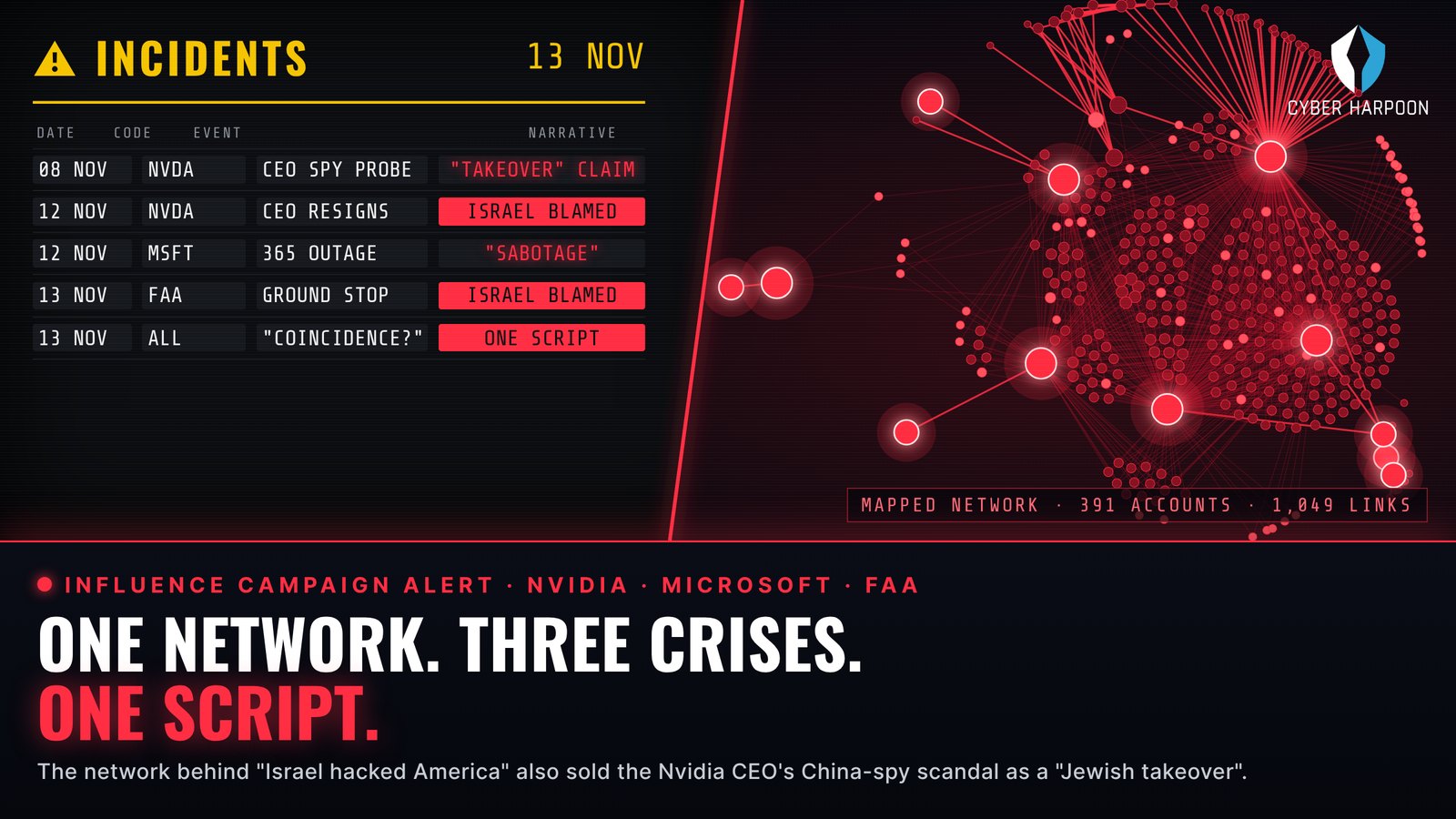
The FAA operation was not a one-off. On November 8, Nvidia opened an investigation into whether CEO Jensen Huang had been targeted by a suspected Chinese intelligence asset; he resigned on November 12. Within days, the same hubs and amplifiers reframed the scandal as an “Israeli takeover of Nvidia” — then chained Nvidia, the Microsoft 365 outage and the FAA ground stop into one coordinated “attack” on America.
- A 30× surge on cue. Israel-framed posts about Nvidia went from 7 on November 8 to 217 the day Huang resigned and 180 the day of the ground stop.
- The same hubs. The account behind the two biggest “Jewish takeover of Nvidia” posts (480K views) was a hub in the Kirk campaign. The author of an FAA “Israel hacked America” seed posted the Nvidia version too.
- The same audience. 15.7% of the 5,418 accounts that spread the top Nvidia posts had already pushed the FAA story, against a 6% baseline. 102 of the 280 core FAA amplifiers came back.
- The same spike. Posts tying Nvidia or Huang to Jews or Israel hit a BADS Mark Score of 5.2× against their 30-day baseline. 16 of the 468 accounts pushing that framing were BADS-marked.
6. The Objective: A Divided, Distrustful America
The anti-Israel content is the vehicle, not the destination. Every version of the story ends in the same place: the media is covering up, the government is lying, and your fellow Americans are the enemy. Each crisis the network exploits deepens polarization and erodes trust in national news organizations and in state and federal authorities. That erosion is the real damage.
7. What to Watch Next
A doom narrative pointing to November 17 was seeded before the outage. That afternoon, at 2:20 PM ET, FEMA and the FCC run a national Emergency Alert System test on TV, radio and cable. Expect any glitch to be sold as “phase two.”
For organizations
- Brief staff and customers now: Friday’s outage was a telecom failure, not an attack.
- Prepare a holding statement for the alert test.
- Don’t amplify AI-chatbot “confirmations” of breaking events.
- Treat sudden waves of identical replies under your posts as a signal, not as public opinion.
- Expect the next outage, scandal or market shock to be pulled into the same story within hours.
What we are, and aren’t, claiming
A BADS mark flags an account showing automation indicators; it is not proof that any single account is automated. Mark Scores measure volume against baseline, and part of every spike is organic. “Likely the same network” rests on shared architecture, narrative and accounts; we have not attributed the operation to a state actor. Separate reporting describes a pro-Nvidia sockpuppet network linked to an Israel-based firm; it is a different operation pushing the opposite message and is not part of these findings. Accounts are described rather than named on this page; client reports carry the full attribution.
Need the full picture?
Clients receive the interactive intelligence dashboard, the full link analysis with account-level detail, and a watchlist for the November 17 window. Contact our team for a briefing.
Sources
Official facts and reporting
- AVweb — FAA nationwide ground stop lifts. avweb.com/aviation-news/faa-nationwide-ground-stop-lifts/
- NPR Illinois — FAA lifts the nationwide ground stop for all U.S. airports, Nov 13, 2026. nprillinois.org
- NVIDIA Corp. — Form 8-K, CEO transition, Nov 12, 2026. sec.gov
- AP via OPB — Nvidia investigates whether CEO Jensen Huang was targeted by a Chinese spy, Nov 9, 2026. opb.org
- Wiley — Nationwide EAS test coming November 17, 2026. wiley.law